TikTok Beauty Trends – September 2026
Glitter Tattooing
Long relegated to children’s birthday parties and fairgrounds, glitter tattooing is making a comeback on TikTok in a more stylised form. This sparkling temporary makeup, applied using stencils or drawn by hand, is leaving the playground behind to become the latest accessory for IT girls. Across social media, videos are multiplying: iridescent butterflies across the back, metallic stars on the shoulders, reworked tribal motifs and silver lettering. Once considered kitsch, the practice is now being reintroduced through contemporary beauty codes.
@sophiehannah save this down for your festi makeup inspo ✨ #diy #glittertattoo #glittermakeup #stencils ♬ Please Please Please x Super Trouper – ALTÉGO
This resurgence is part of a broader return to Y2K references and an ultra-saturated pop aesthetic in which the body once again becomes a playground for experimentation. Celebrities are playing a key role. Zara Larsson has helped bring the practice back into the spotlight with the glittering butterfly tattoos she wears across her back, reminiscent of the hyper-feminine pop stars of the era. By contrast, Kylie Jenner incorporates it into a much more polished universe through Khy campaigns.
@shopamare_ Glitter tattoos with your besties 💛🐬 #fyp #matching #bestfriend #aesthetic #2016 ♬ original sound – Song Lyrics
Beyond nostalgia, the success of glitter tattooing also reflects a shift in the way younger generations approach appearance. New beauty practices are increasingly embracing temporality. The body becomes a playground, a surface for self-expression that can be transformed according to mood. These ephemeral tattoos perfectly align with the logic of visibility: they sparkle on camera and capture attention within seconds. Their virality also points to a broader shift in today’s beauty codes, where the goal is no longer to achieve a form of naturalness, but to embrace a visible and playful sense of artificiality. After several years dominated by the discourse around the Clean Girl aesthetic, this trend reveals a broader desire to bring playfulness back into beauty routines.
@xsonikax so obsessed with this! I wanna see more glitter tatts and body art🪩✨ ib: @Paintedbyesther @Sophia Sinot @VO5 hair gel @Anastasia Beverly Hills glitter @Lethal Cosmetics gems #bodyart #glittertattoo #y2kbeauty #early2000s ♬ original sound – rithu
For brands, glitter tattooing offers a way to rethink makeup as an ephemeral, visual and shareable experience. What appeals today is not simply the return of Y2K codes, but the freedom this aesthetic offers: a more spontaneous, playful and less fixed relationship with beauty.
#ProjectPan
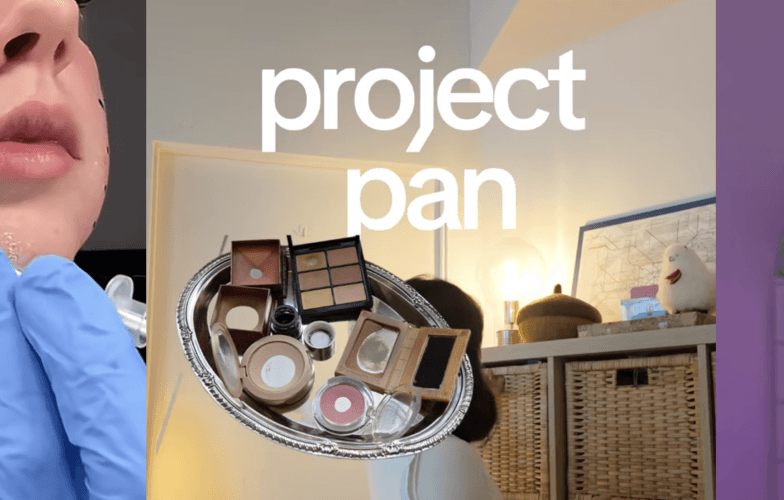
After several years dominated by endless launches and hauls, TikTok seems to be shifting towards a more mindful approach to beauty consumption. “Project Pan” has emerged as one expression of this return to restraint. Inspired by an almost forgotten habit — finishing products before buying new ones — the trend moves away from accumulation and towards making the most of what we already own. Foundations used down to the last drop, eyeshadows worn down to the pan and lipsticks used until the very last application are gradually replacing hauls.
@jessportra A little late to the trend, but it’s never too late to save more money and consume less 🙂 #finance #personalfinance #moneytips ♬ original sound – Jess 👩🏻💻📈🌱
The term comes from the English word “pan”, referring to the metal base that becomes visible at the bottom of a makeup product when it is nearly finished. The challenge consists of selecting several products already in one’s collection — makeup, skincare or fragrance — and committing to using them until the very last drop. In an industry often perceived as an endless cycle of new products to buy, younger generations seem to be looking for more conscious forms of consumption.
On TikTok, Project Pan is built around an aesthetic of transparency. Creators document every step: selecting their products, tracking their monthly progress and sharing the satisfaction of seeing the coveted “pan” appear. Far from being experienced as a constraint, the ritual becomes a symbol of self-control, almost therapeutic in a world driven by instant consumption. But beyond the act itself, Project Pan reflects a broader questioning of beauty consumption. TikTok follow-up videos often come with reflections on what we actually use, what works for our skin, and what truly fits our everyday lives and desires.
@cocopaillette EMPTIES 💖 les produits terminés en mai @Typology Paris (offert) @The Ordinary (offert) @Nuxe @Boutique Holidermie (offerts @My Little Box ) #projectpan #empties #skincare #makeup #cheveux ♬ son original – cocopaillette
For brands, Project Pan represents more than just an anti-consumption trend. The focus is no longer on constant renewal, but on longevity. This can translate into smart formats designed to be used to the very end, communication around product durability and a greater emphasis on performance over time.
Female Looksmaxxing
On TikTok, a new vocabulary is gradually taking over beauty conversations. Forget simple makeup or skincare tips: terms like “recessed maxilla”, “canthal tilt”, “orbicularis oculi” and “phenotype” are becoming increasingly common. Long associated with male looksmaxxing communities, this pseudo-scientific vocabulary is now being adopted by a growing number of female creators.
At first glance, these videos look like any other beauty content. One creator explains how to enhance the appearance of her eyes through facial exercises, another analyses her facial structure or shares tips for optimising her profile. What changes is the language used to describe perceived imperfections. Rather than relying on traditional beauty vocabulary, creators turn to terms borrowed from biomechanics, anatomy and medicine.
@greta.div #looksmax #looksmaxx #looksmaxing #makeuptipstiktok ♬ The Typewriter’s Samba – Jazz Language
For decades, female beauty practices have often been dismissed as superficial. By contrast, looksmaxxing, which emerged within male communities, framed the same pursuit of physical improvement through the lens of science and optimisation. By adopting this vocabulary, some women are seeking to give greater credibility to their aesthetic concerns, transforming self-care into an almost clinical process. By objectifying the face through measurements, ratios and technical terminology, it reinforces the idea that every feature should be optimised. The focus is no longer solely on the aesthetic result, but on identifying new “flaws” to correct.
@ry.maxx First session planning on 2 more #lm #bp #aqualyx ♬ tell me that u love me (slowed) – SUICIDAL-IDOL & Pröz
For brands, this evolution calls for a rethink of how expertise is communicated. Consumers are increasingly looking for educational and credible content, but the risk is that every beauty concern becomes a technical problem to solve. The challenge is therefore to strike a balance between scientific credibility and a more emotional approach to beauty, without feeding into an overly clinical vision of appearance.