TikTok Beauty Trends – April 2026
China Maxxing
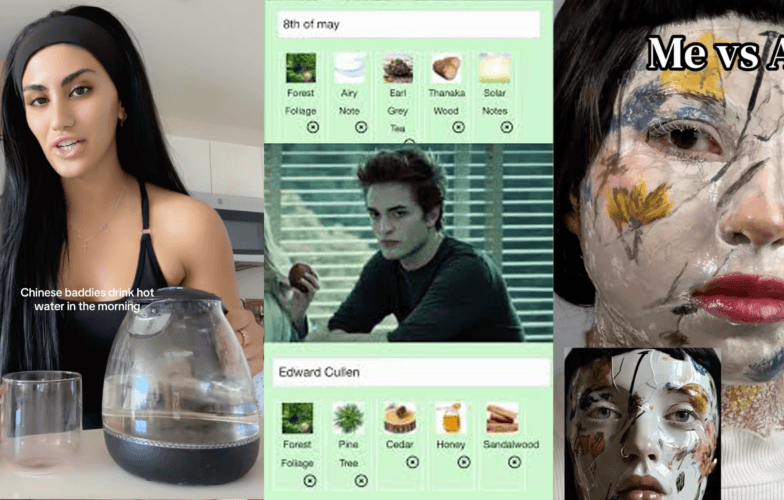
On TikTok, China Maxxing (a contraction of “maximizing”) is emerging as one of the most intriguing trends of the moment. Behind this viral label lies a fascination with lifestyles perceived as more balanced, grounded, and deeply holistic. The platform is seeing the rise of practices inspired (sometimes idealized) by everyday Chinese habits: drinking hot water, adopting routines rooted in traditional medicine, practicing qi gong, or cooking dishes like congee. Simple habits elevated to the status of rituals, prioritizing gentle regulation of body and mind over quick fixes.
@mandanazarghami this will improve your gut health, skin health, and digestion🌱 #health #wellness #guthealth #hotwater ♬ house song – searows
In a context of widespread fatigue and underlying anxiety, this enthusiasm reflects a growing need to slow down and reintroduce meaning into daily life. Where Western medicine is often seen as reactive, intervening once imbalance has already set in, approaches rooted in Chinese traditions emphasize prevention, attentiveness to subtle signals, and the pursuit of harmony. This contrast, even if simplified, reinforces the appeal of a more holistic and less fragmented vision of care.
The viral mantra “I’m in a very Chinese time of my life” captures this shift: adopting these practices becomes both a tool for well-being and a symbolic, almost transgressive gesture, distancing oneself from a Western model perceived as exhausting and saturated in its responses to contemporary issues. In this sense, China Maxxing contributes to a form of diffuse soft power, where lifestyle becomes a vector of influence, desirability, and a certain ideal of global well-being.
@nmmalaika got the slippers too #chinesebaddie @sherry ♬ original sound – alex
et this appropriation also reveals a tension. Between homage, naïve curiosity, and oversimplification, the trend oscillates. As often on TikTok, cultural complexity – particularly that of traditional Chinese medicine, based on subtle balances between energy, diet, and rhythm of life – is condensed into a series of easily replicable codes, turning a deeply systemic approach to care into an aesthetic that risks becoming too accessible.
At its core, what emerges is a deep need to slow down, reintroduce ritual, and rehabilitate a form of continuous, almost invisible care. For brands, the temptation to ride the wave is strong, but so is the risk of caricature. The challenge is to create experiences that are more accurate, more sustainable, and less superficial. In that sense, China Maxxing goes beyond a passing trend: it signals a shift toward a more patient narrative, centered on experience and everyday attentiveness to the body.
Fragrantica Nostalgia Core
Nostalgia is now one of the most powerful drivers of fragrance trends on TikTok. In line with the broader “-core” aesthetics, nostalgia core romanticizes the past through images, textures, and memories, creating an immediate emotional connection with audiences. The world of fragrance is particularly suited to this dynamic: scent is deeply tied to memory and emotion, naturally amplifying the impact of this type of content.
Within this context, Fragrantica nostalgia core is emerging – a variation where creators use the Fragrantica website as a tool for sensory translation. The concept is simple yet effective: start from an image or a memory (a childhood bedroom, a summer by the sea), then identify the olfactory notes capable of bringing it back to life. Thanks to search tools based on notes and accords, these memories become “searchable,” transforming an abstract emotion into a concrete list of scents.
@tv.deadpixel If my childhood nostalgic moments were perfume #fragrantica#nostalgiacore#perfume #trend#fyp ♬ son original – tv.deadpixel
What makes this trend especially viral is its narrative format. Creators no longer describe technical notes—they tell stories. “A snowy day with no school,” “the last summer before college,” “an afternoon at the beach.” These tangible, universal references make it easier for audiences to project themselves and engage. They also rely on a kind of intuitive olfactory grammar, where certain memories almost naturally call for specific accords: powdery notes for childhood, marine notes for the seaside, and so on.
For brands, the implications are significant. They are no longer the sole authors of the narrative around their creations: consumers are now appropriating fragrances as tools for personal projection, favoring those capable of evoking a specific memory or sensation. This shift calls for moving away from storytelling centered on prestige or seduction toward something more sensory, evocative, and personal. Brands that can inhabit these imaginaries, by creating distinctive and emotionally resonant olfactory worlds, will be best positioned to leverage this dynamic.
@songs.by.adrianne.lenker nostalgia is going to be the death of me #2000s #scents #nostalgia #fyp #fragrantica ♬ son original – Sam★
Me Vs. AI
On TikTok, a new makeup trend is gaining traction: the “Me vs. AI” challenge. The concept is as simple as it is ambitious: beauty creators take on AI-generated looks and attempt to recreate—or even surpass—them on their own faces.
These AI-generated looks are often spectacular, almost unreal. Reproducing them requires an exceptional level of technical skill, often involving hours of work to approximate an image generated in seconds by an algorithm. Creators such as @painterka, @michmoonmakeup and @natashajanewood have embraced the challenge with striking results, racking up millions of views. Each video becomes a standalone artistic performance.
@painterka Part 2 | pojedynek moich umiejętności ze sztuczną inteligencją 👊 kto wygrał tym razem? 🤖 daj znać! #aimakeup #makijaż #charakteryzacja #makeupart #metalicmakeup ♬ Kikay – Viva Hot Babes
This is where the deeper question behind the trend emerges: what is an image worth if no one has truly lived it? Artificial intelligence can generate a perfect look instantly, but it knows nothing of the hesitant gesture, the brush picked up three times, or the spontaneous decision to change a color mid-process. Ultimately, what matters is not just the result, but the creative journey – the sensitivity, the craftsmanship, the unique signature of each artist. Two makeup artists starting from the same AI-generated visual will never produce the same outcome, and that’s precisely where value lies: in interpretation, adaptation, and the decisions made along the way. More than the final result, it’s the path taken to get there that becomes compelling to watch and share.
“Me vs. AI” highlights a key issue for brands: AI does not replace human skill, it transforms it. It becomes a starting point, a source of inspiration that individuals can interpret according to their level, tools, or style. The question is no longer whether to use AI, but how to help consumers engage with it in an accessible, non-intimidating way.